A Guide to Croatia's Pleter: The Ancient Interlace Pattern That Defines a Nation
Discover the history and meaning of Croatia's distinctive interlace ornament, found on ancient stone carvings and still used as a national symbol today.
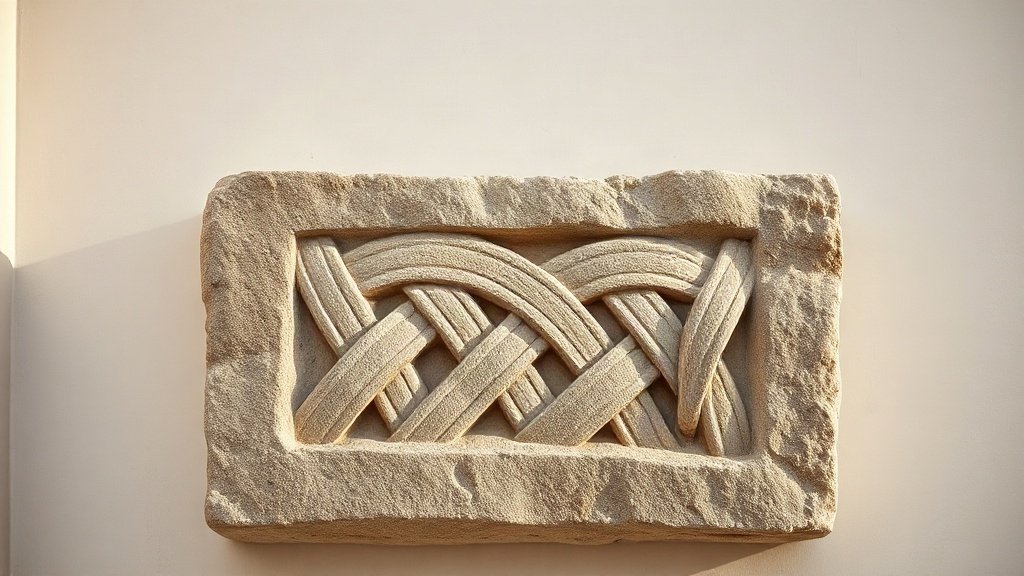
Illustration: AI-generated image
Croatia’s rich cultural heritage is full of distinctive motifs, but few are as instantly recognisable as the pleter. This ornate interlace pattern, carved into stone over a thousand years ago, has become one of the nation’s most enduring symbols.
The pleter, also known as the Croatian interlace, is a form of decorative braided ornament made from three parallel bands that weave over and under one another in a continuous geometric design. It appears most famously on pre-Romanesque stone monuments from the 9th to the 11th centuries, when early Croatian rulers commissioned churches, altars, and baptismal fonts across the Dalmatian coast and hinterland.
The pattern is believed to have been inspired by similar interlacing designs found in late antique and early Byzantine art, but Croatian stonemasons developed their own distinctive style, characterised by precise, symmetrical loops and a sense of rhythmic movement. Scholars have interpreted the three-ribbon structure as a symbol of the Holy Trinity, or as a visual representation of eternity, with no beginning or end. Unlike the more familiar Celtic knot, which often uses a single continuous ribbon, the pleter’s three-strand braid gives it a unique texture and depth.
Some of the finest surviving examples are held in the Museum of Croatian Archaeological Monuments in Split, which preserves stone fragments from early medieval churches throughout the country. One of the most celebrated artefacts featuring the pleter is the baptismal font of Prince Višeslav, believed to date from around 800 AD and now kept in the baptistery of St. John in Split. Another masterpiece is the sarcophagus of Queen Jelena, discovered in the Church of St. Mary in Zadar, where the interlace surrounds an inscription in Latin.
Travelling through historic towns such as Zadar, Trogir, and Šibenik, you may also spot pleter carvings on church façades, bell towers, and even modern public buildings, where the motif has been incorporated as a nod to national heritage. In the 19th century, during the Croatian national revival, the pleter was embraced as a symbol of identity and continuity. Today, it appears on state decorations like the Order of the Croatian Pleter, and it can be found in everything from jewellery design to tourist souvenirs.
Many visitors enjoy seeking out the pleter as a kind of cultural treasure hunt, whether on the ancient stone screens of a medieval church or woven into contemporary crafts at a local market. Understanding the pleter is a wonderful way to connect with Croatia’s layered past. Next time you wander through a historic town or browse a traditional craft shop, take a closer look – you may just spot these timeless interwoven lines telling the story of a proud and enduring culture.