A Guide to the Sinjska Alka: Croatia's Knightly Tournament
Held every August in the Dalmatian town of Sinj, the Alka is a spectacular knightly competition with roots in an 18th-century victory over the Ottoman army. Here's what to expect and how to experience it.
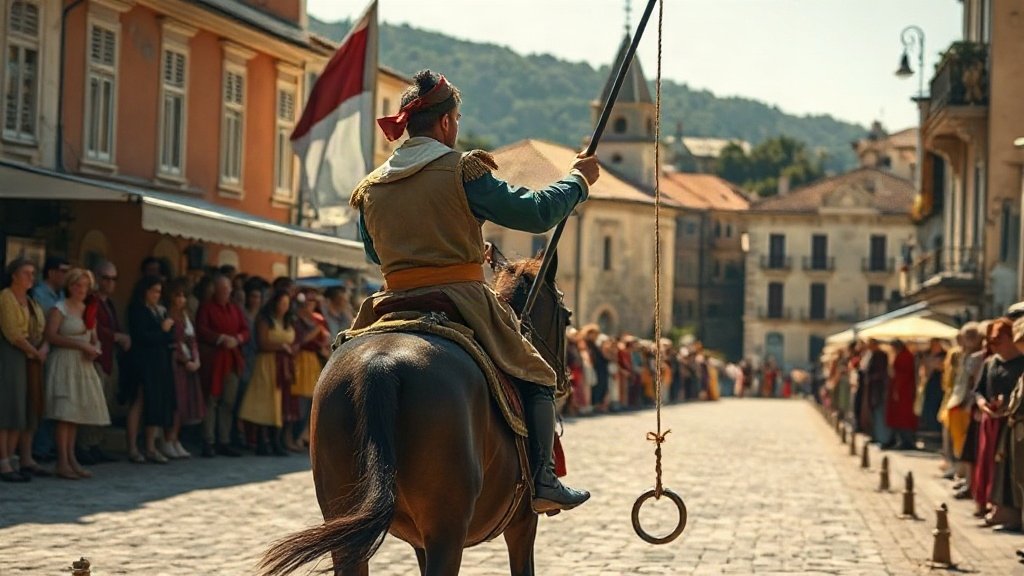
Illustration: AI-generated image
Every first Sunday in August, the small Dalmatian town of Sinj transforms into a stage for one of Croatia's most dramatic traditions: the Sinjska Alka. This knightly tournament, which has taken place almost without interruption since 1715, sees horsemen in 18th-century costume galloping at full speed to aim their lances at a suspended metal ring. It is a spectacle of skill, courage and local pride, and watching it is an unforgettable experience for any visitor to Croatia.
A 300-Year-Old Tradition
The Alka dates back to 1715, when the people of Sinj successfully defended their town against a much larger Ottoman army. According to local history, the victory was attributed to the intervention of the Madonna of Sinj, and the tournament was established as an annual act of thanksgiving. Over the centuries, the event has evolved but has always retained its original purpose: to celebrate the town's resilience and honour its defenders.
The competition is named after the alka, a metal ring made of two concentric circles connected by three bars. The ring is suspended on a rope across the main street of Sinj, and competitors, known as alkari, must hit it with a lance while riding at a gallop. The target is small, and the margin for error is tiny, making the contest both thrilling and demanding.
The Competition Itself
The Alka follows strict rules that have remained largely unchanged for centuries. Each alkar makes three runs down the 160-metre course, aiming to strike the ring's central circle, known as the srida, for maximum points. Hitting the upper or lower sections earns fewer points, while missing the ring entirely scores nothing. The alkar with the highest total score is declared the slavodobitnik, or victor, and receives a prize along with the honour of leading a victory lap.
Before the competition begins, a colourful procession of alkari, their squires and other participants parades through the town in historical dress. The atmosphere is electric, with locals cheering on their favourites and visitors joining in the excitement. The event is so significant that in 2010, UNESCO inscribed the Sinjska Alka on its Representative List of the Intangible Cultural Heritage of Humanity.
Planning Your Visit
If you plan to attend, it's best to arrive early, as Sinj's small centre fills up quickly. The town is about 30 kilometres inland from Split, making it an easy day trip by car or bus. While some grandstand seating is reserved, there are free viewing areas along the course, though standing for the duration of the competition is common. Bring water, sun protection and comfortable shoes, as August in Dalmatia is hot.
The Alka typically takes around three to four hours, with the main event starting in the late afternoon. Afterward, the streets of Sinj come alive with music, food and celebration. It's a wonderful opportunity to taste local specialities such as arambašići (stuffed cabbage rolls) or sinjski uštipci (fried dough balls).
Beyond the Alka: Exploring Sinj
While the Alka is the town's most famous event, Sinj has plenty to offer year-round. The Alkarski dvori (Alka Court) houses a museum dedicated to the tournament, with displays of historical costumes, lances and the rings themselves. Nearby, the Church of the Miraculous Madonna of Sinj is an important pilgrimage site, and the Cetina River offers opportunities for swimming, rafting and hiking in its beautiful canyon.