A Slow Guide to Kopački Rit: Croatia's Flooded Forest Wilderness
Explore one of Europe's largest wetlands, where boardwalks wind through ancient willow forests and white-tailed eagles soar overhead.
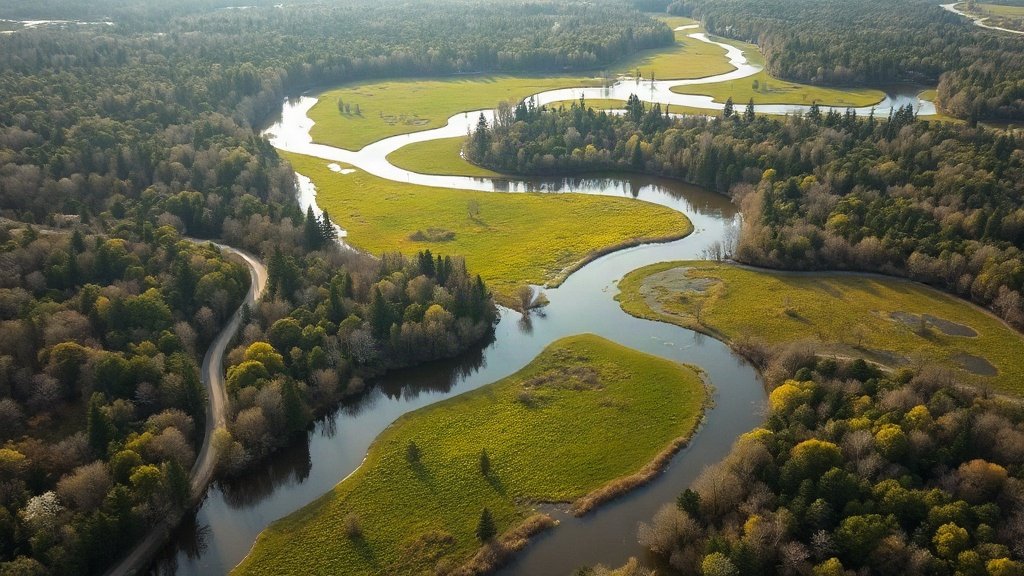
Illustration: AI-generated image
In the far east of Croatia, where the Drava meets the Danube, lies one of Europe's largest and most important floodplains. Kopački Rit Nature Park is a maze of backwaters, marshes and ancient willow forests that floods each spring, creating a dynamic landscape teeming with wildlife.
A wetland wilderness
Kopački Rit covers around 177 square kilometres, though its exact size shifts with the seasons. Each year, the Danube and Drava rivers swell, transforming the park into a shallow inland sea. As the waters recede, they leave behind a patchwork of pools, channels and mudflats that support an astonishing variety of life. The park is part of the wider Danube-Drava National Park and has been protected since 1967; it is also recognised as a Ramsar wetland of international importance and forms part of the UNESCO Mura-Drava-Danube Biosphere Reserve.
The landscape is dominated by floodplain forests of willow, poplar and oak. Some of these woods are over a hundred years old, their trunks rising from dark water and their branches draped in vines. Between the forests, open marshes and wet meadows stretch to the horizon, broken only by the occasional heron or the silhouette of a deer.
Wildlife watching
Kopački Rit is a birdwatcher's paradise. More than 290 bird species have been recorded here, including rare and emblematic ones. The white-tailed eagle, one of Europe's largest birds of prey, nests in the park and can often be seen soaring over the water. Black storks, spoonbills, purple herons and little egrets are common sights, while thousands of waterfowl stop over during migration. In winter, the flooded forests fill with teal, wigeon and other ducks.
Mammals are harder to spot but present throughout the park, including red deer, wild boar, otters and beavers. The best times for wildlife watching are early morning and late afternoon, when animals are most active. Binoculars are essential, and a bit of patience is usually rewarded.
Exploring the park
Most visitors enter Kopački Rit from the villages of Bilje or Kopačevo, a short drive from Osijek. The park has a network of walking trails and boardwalks that allow you to explore without getting your feet wet. One of the most popular routes follows the embankments and dykes, offering panoramic views over the wetlands. Several observation towers provide elevated vantage points for photography and birding.
Boat tours are another highlight. Traditional flat-bottomed boats glide silently through narrow channels, taking you deep into the flooded forest where larger vessels cannot go. Guides often share knowledge about the park's ecology and point out wildlife along the way. Kayaking and canoeing are also possible in certain areas, giving a more active perspective. Cycling is permitted on designated paths, and the flat terrain makes it accessible for most riders.
Practical tips
Kopački Rit is easiest to reach from Osijek, the largest city in Slavonia, about 10 kilometres away. Public transport is limited, so a car or organised tour is the most convenient option. The park is open year-round, but the character of the landscape changes dramatically. Spring (April to June) is the most spectacular, with high water levels and abundant birdlife. Autumn (September to October) offers mild weather and fewer insects, while winter is quiet and atmospheric. Summer can be hot and buggy, so bring insect repellent and plenty of water.
Wear sturdy shoes or boots, as trails can be muddy, and dress in layers—morning mists give way to warm afternoons. There are basic visitor facilities near the entrance, but food and accommodation are best found in Osijek or the surrounding villages. A visit to Kopački Rit offers a side of Croatia far from the Adriatic crowds—a quiet, green world shaped by water and time.