Za Križen: A Guide to Hvar's Sacred Maundy Thursday Procession
Every Maundy Thursday, the island of Hvar comes alive with one of Croatia's most profound religious traditions. Here's what to know about Za Križen, the night-long procession following the cross.
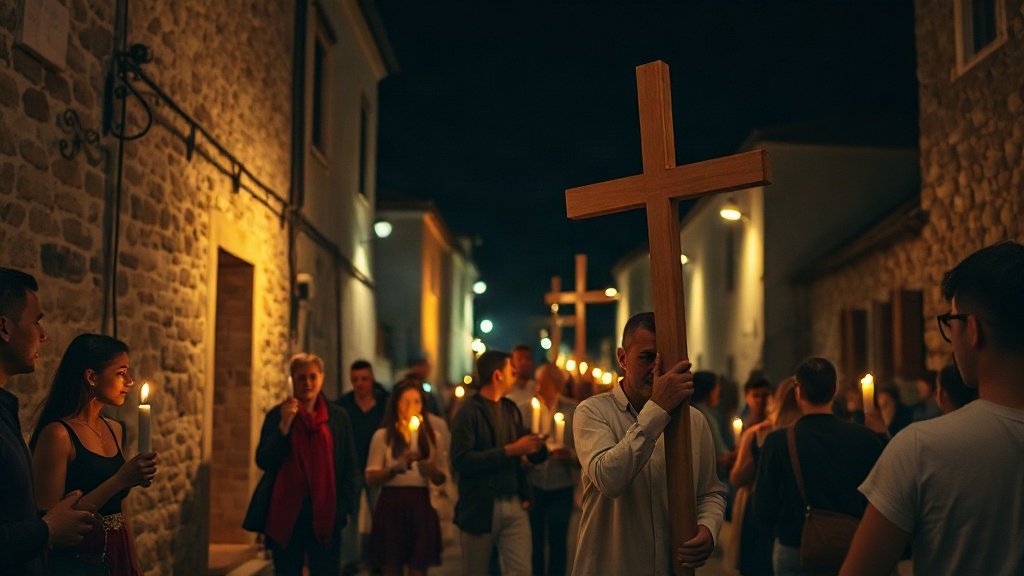
Illustration: AI-generated image
On the island of Hvar, the night before Good Friday is unlike anywhere else in Croatia. As darkness falls on Maundy Thursday, six separate processions set out from six parish churches, each following a single cross carried by a devoted cross-bearer. This is Za Križen, or "Following the Cross," a centuries-old tradition that has become a defining symbol of faith and community on the island.
Origins of the tradition
Za Križen has deep roots in Hvar's religious history, with records of the procession dating back to at least the 16th century. It emerged as a local expression of penance and devotion, particularly during times of hardship such as plague and famine. Over the centuries, the ritual has remained remarkably unchanged, passed down through generations of islanders.
In 2009, UNESCO recognised Za Križen as an Intangible Cultural Heritage of Humanity, cementing its importance not just for Hvar but for the world.
The night-long procession
The six processions begin simultaneously from the towns of Jelsa, Pitve, Vrisnik, Svirče, Vrbanj, and Vrboska. Each is led by a cross-bearer, a local man who has chosen—often as a personal vow—to carry a heavy wooden cross, weighing up to 18 kilograms, for the entire night. Many walk barefoot or in socks, adding to the physical challenge.
The route covers approximately 25 kilometres, winding through the island's central hills and connecting the six churches. Each procession follows a prescribed path so that the crosses visit every church along the way, eventually returning to their starting point as dawn breaks on Good Friday. The processions never meet directly; instead, they pass one another at a distance, a symbolic nod to the biblical story of the Passion.
The cross-bearer's role is not taken lightly. He is chosen by the parish community and often prepares for months, both physically and spiritually. Carrying the cross through the night is seen as an act of deep personal sacrifice and devotion, and many islanders consider it one of the highest honours.
Accompanied by hundreds of parishioners, the cross-bearer leads the group in prayer and song. The atmosphere is solemn yet deeply moving, with candlelight and traditional hymns filling the night air.
Despite modern changes, Za Križen has retained its core elements. The processions still follow the same routes and prayers, and the cross-bearers still walk the entire distance. For many residents of Hvar, participating is a rite of passage and a crucial link to their heritage.
Witnessing Za Križen
Visitors are welcome to observe the procession respectfully. The best places to see it are in the starting towns, where you can watch the departure around 10 pm on Maundy Thursday, or along the routes in the early hours. It is important to remember that this is a religious event; silence and modesty are expected from onlookers.
While the exact date changes each year with Easter, the tradition remains a powerful constant on Hvar's calendar—a reminder of faith, endurance, and community that has survived for centuries.