How to Make Štrukli: Croatia's Beloved Cheese Pastry
Discover the comforting world of štrukli, a traditional Croatian pastry filled with creamy cheese. Learn how to make both baked and boiled versions at home.
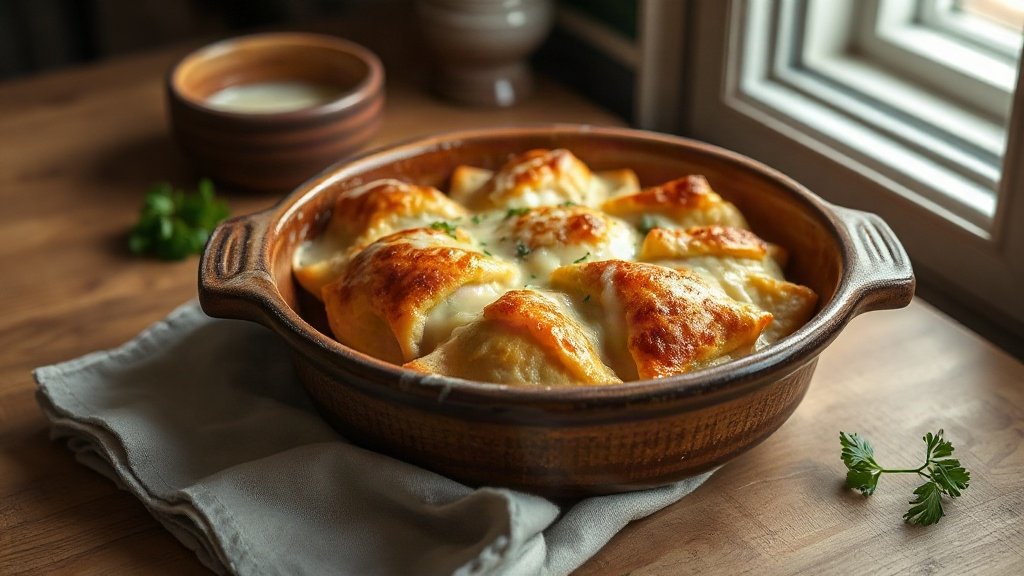
Illustration: AI-generated image
If there is one dish that sums up the comforting, homely side of Croatian cooking, it is štrukli. This simple pastry, filled with fresh cow's cheese and often enriched with sour cream and eggs, has been a staple in the northern regions of Croatia for centuries. It is at once humble and indulgent, and once you master the basic technique, you can vary it endlessly.
What are štrukli?
Štrukli are a traditional Croatian dish, particularly associated with Hrvatsko Zagorje and the capital, Zagreb. The name comes from the German word strudel, but unlike the sweet apple strudel, štrukli are usually savoury. The dough is rolled thin, filled with a mixture of fresh cheese, eggs, and sour cream, then either boiled or baked. The result is soft, creamy, and deeply satisfying.
There are two main types: kuhani štrukli (boiled) and pečeni štrukli (baked). Boiled štrukli are delicate and tender, often served in a light broth or with a drizzle of melted butter. Baked štrukli have a golden, crispy top and a molten centre—somewhere between a lasagne and a savoury bread pudding.
The essential ingredients
The ingredient list is short, but quality matters. You will need:
- Plain flour, for the dough
- Fresh cow's cheese (such as svježi sir or a mild ricotta)
- Eggs
- Sour cream (kiselo vrhnje)
- Salt
- Butter or oil, for greasing and finishing
Some families add a little sugar to the dough, and a splash of milk or water to bring it together. The cheese should be well drained; if it is too wet, the filling will be runny.
How to make the dough
The dough for štrukli is similar to fresh pasta. Combine flour, a pinch of salt, one egg, and just enough warm water to form a soft but not sticky ball. Knead it for about ten minutes until smooth and elastic, then cover and let it rest for half an hour. Resting relaxes the gluten and makes the dough easier to roll thin.
On a lightly floured surface, roll the dough into a large rectangle, as thin as you can—ideally almost translucent. Some cooks stretch it by hand, but a rolling pin works fine. The thinner the dough, the more delicate the final dish.
Preparing the filling and shaping
In a bowl, mix the fresh cheese with one or two eggs, a few spoonfuls of sour cream, and a pinch of salt. The mixture should be spreadable but not too loose. Spread the filling evenly over the rolled dough, leaving a small border. Then, starting from one long side, roll the dough up like a Swiss roll. Press the seam gently to seal.
For boiled štrukli, cut the roll into thick slices, about five centimetres wide, and drop them into salted boiling water. They are ready when they float to the surface, usually after five to eight minutes. For baked štrukli, place the whole roll—or slices arranged snugly—in a buttered baking dish. Pour over a little sour cream and dot with butter, then bake at 180°C until golden and bubbling, around 30 to 40 minutes.
Serving ideas and variations
Štrukli are wonderfully versatile. Serve boiled štrukli as a starter or light main, topped with toasted breadcrumbs and melted butter, or in a clear soup. Baked štrukli make a hearty main course, often paired with a simple green salad. They can also be made sweet by adding sugar and vanilla to the filling, and serving with a dusting of icing sugar or a spoonful of jam.
Every family has its own twist. Some add finely chopped spinach or nettles to the cheese, others use pumpkin or apple for a seasonal version. The only rule is to use good, fresh ingredients and plenty of patience when rolling the dough.
Once you have made štrukli a few times, you will understand why this humble pastry is so loved across Croatia. It is the taste of Sunday lunches, village fairs, and grandmothers' kitchens—simple, generous, and made to be shared.