A Guide to Plitvice Lakes: Croatia's Waterfall Wonderland
Discover turquoise lakes, tumbling waterfalls and wooden walkways in Croatia's oldest and largest national park. Plan your visit with these practical tips.
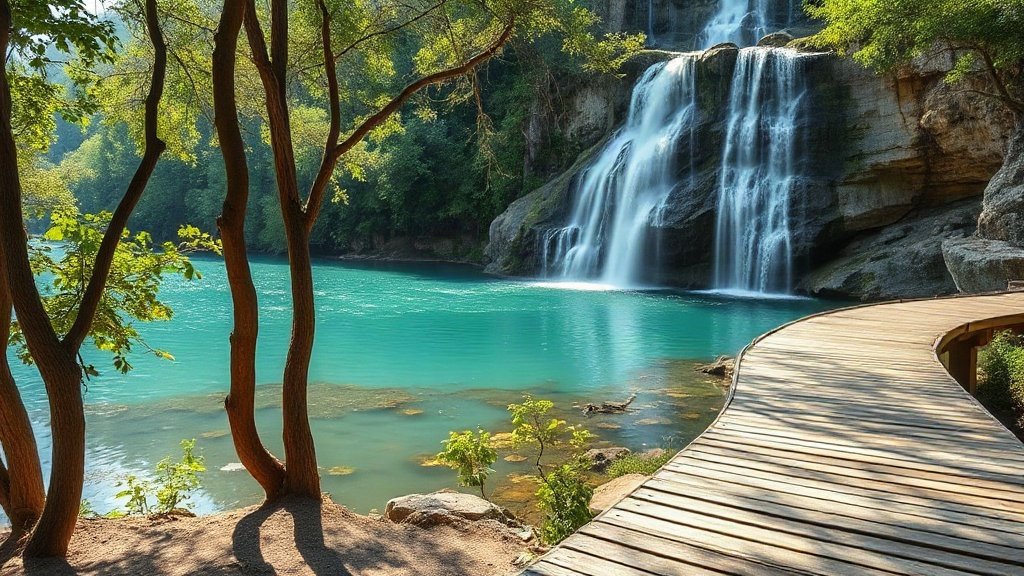
Illustration: AI-generated image
Plitvice Lakes National Park, a UNESCO World Heritage site since 1979, is Croatia's oldest and largest national park, founded in 1949. Located in the mountainous karst region of central Croatia, roughly halfway between Zagreb and the Adriatic coast, it is a landscape of water and stone: sixteen terraced lakes, countless waterfalls, and forests of beech, fir and spruce.
The Lakes and Waterfalls
The lakes are divided into the Upper Lakes (Gornja jezera) and Lower Lakes (Donja jezera), separated by a band of dolomite. The Upper Lakes are larger and quieter, set in a gentle valley and surrounded by thick woods; the Lower Lakes are smaller, shallower and more dramatic, carved into a limestone canyon. The chain ends with Veliki Slap, the Big Waterfall, which plunges 78 metres into the Korana River. The water's remarkable turquoise and green hues come from dissolved calcium carbonate and the growth of travertine barriers, which are constantly forming and reshaping the lakes and falls. This living geology is one reason the park is so carefully protected.
A Natural and Cultural Treasure
Plitvice was first proposed as a protected area in the late 19th century, and became a national park in 1949, the first in Croatia. Its global importance was recognised in 1979 when it was inscribed on the UNESCO World Heritage list. The park covers nearly 300 square kilometres, though most visitors focus on the lake system itself. The area has long been shaped by water, and the local communities have adapted to the landscape for centuries, using the rivers for mills and the forests for timber.
Exploring the Park
A network of wooden boardwalks and hiking trails winds over, around and across the water, bringing you face-to-face with tumbling cascades and mirror-still lakes. The park offers several waymarked circular routes, from a relaxed two-hour loop around the Lower Lakes to an all-day hike covering both sections. The most popular is Route B, which covers the Lower Lakes, a boat ride across Lake Kozjak and a return by panoramic train, taking around three to four hours. Route K, the longest, explores both lake sections over six to eight hours. You can pick up a free map at the entrance. An electric boat glides across Lake Kozjak to connect the upper and lower lakes, and a panoramic shuttle train runs between key points, so you can cover more ground without retracing your steps.
When to Visit
Each season paints a different picture. In spring, snowmelt swells the falls to their most powerful; in early summer, the water levels are still high and the forest is lush. Autumn brings a blaze of gold and red, with fewer visitors. Winter can transform the park into a silent, snowy landscape, with frozen waterfalls and frost-covered trees, though some upper sections may be closed. Summer is the busiest time, so if you visit in July or August, try to arrive at opening time or late afternoon to avoid the largest crowds.
Getting There and Around
Plitvice lies just off the main road connecting Zagreb with the Dalmatian coast, making it a natural stop on a road trip between the capital and cities like Zadar or Split. Regular intercity buses serve the park from Zagreb, Zadar, Split and other towns, stopping near both entrances. Within the park, the network of trails, boats and shuttle trains is easy to navigate, with clear signs in Croatian and English. Walking is the best way to soak in the scenery, but the boat and train save time on longer routes.
Practical Tips
- Wear sturdy, non-slip shoes; the boardwalks can be wet, especially near the waterfalls.
- Bring water and snacks, though there are a few simple eateries near the entrances and boat docks.
- Swimming is prohibited anywhere in the park to protect the fragile travertine and aquatic life.
- Stay on the marked paths and boardwalks at all times; stepping off can damage the delicate formations and is not allowed.
- There are two main entrances: Entrance 1 near the Lower Lakes and Entrance 2 near the Upper Lakes. Both have parking, ticket offices, information desks and restrooms.
- Allow at least three to four hours for a reasonable visit; a full day gives time to see both lake sections and take a break.
Whether you have a morning or a full day, Plitvice Lakes rewards slow travel: pause on a boardwalk, listen to the water, and watch the light change on the water. It remains one of Croatia's most treasured natural wonders.