Mars Cliffs Up to 209 Metres Tall Could Reveal Planet's Icy Past
Scientists have identified 29 unusual geological formations near Mars' Alba Mons volcano, potentially remnants of ancient glaciers, with steep cliffs reaching 209 metres high.
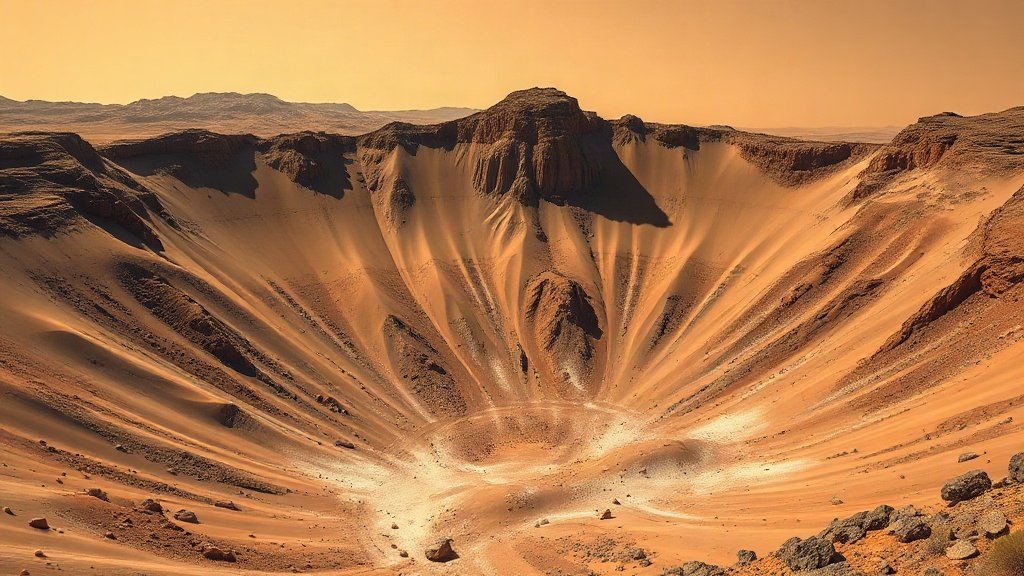
Illustration: AI-generated image
An international team of researchers has discovered 29 unusual geological formations on Mars that could be the remains of ancient glaciers. The structures, found near the Alba Mons volcano in the planet's northern hemisphere, feature steep cliffs up to 209 metres high and may hold important clues about Mars' climatic past.
The findings were published in the scientific journal Earth and Planetary Science Letters. Scientists analysed images from NASA's Mars Reconnaissance Orbiter and the European ExoMars Trace Gas Orbiter, studying a total of 738 craters. By combining views from different angles, they created three-dimensional models of the surface.
Of the 29 deposits identified, 24 lie inside impact craters, while the remaining five were found in other depressions. The formations stretch down slopes for one to three kilometres and end in remarkably steep cliffs, with some slopes angled at up to 42 degrees. The tallest cliff reaches 209 metres.
Researchers believe these structures are most likely large bodies of ice that slowly moved downhill in the past, similar to glaciers on Earth. However, unlike terrestrial glaciers, the Martian formations are covered by layers of rock, dust and other debris. This protective layer may have stopped the ice from being directly exposed to Mars' thin atmosphere, allowing it to survive for a very long time.
Interestingly, all of the deposits are on slopes facing the planet's north pole. In those positions, ice is more shielded from solar radiation, which helps it persist. The team suggests that the steep cliffs formed through sublimation — the process where ice turns directly into gas without melting first, due to Mars' extremely low atmospheric pressure.
The researchers compared the Martian features to similar structures on Iceland and found notable similarities with the ends of debris-covered glaciers. However, they caution that their explanation still needs further verification, as the composition and internal structure of the formations have not been directly examined.
This discovery could provide new information about the major climate changes Mars has undergone. Unlike Earth's relatively stable rotation axis, the tilt of Mars' axis has changed significantly over geological time, affecting the distribution of solar energy and the movement of water. According to climate models, these possible glaciers may have formed during a colder period when Mars' axis was more tilted than today, allowing ice to accumulate at latitudes where it cannot form on the open surface now.