A Slow Guide to Mljet: Croatia's Greenest Island
Explore the lush forests, saltwater lakes and ancient monastery of Mljet, a tranquil escape in southern Dalmatia.
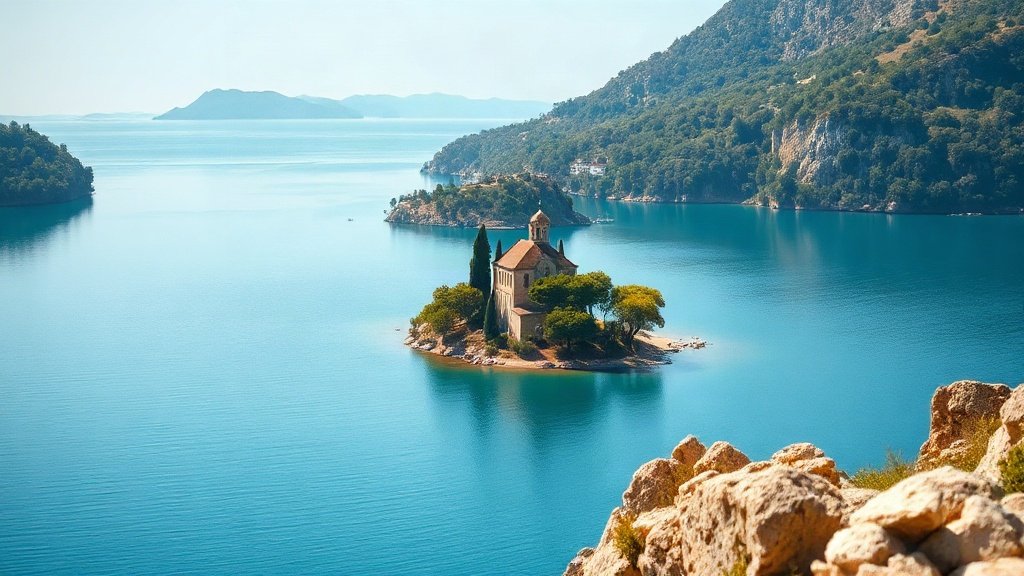
Illustration: AI-generated image
Mljet is the greenest and most forested island in the Adriatic, a place where the scent of pine mingles with salt air and time seems to move at its own gentle pace. The western third of the island is protected as Mljet National Park, a landscape of dense woodland, two extraordinary saltwater lakes and a tiny islet crowned by a medieval monastery. If you are looking for a true escape from the crowds, Mljet delivers calm in abundance.
Why visit Mljet?
Unlike Croatia's better-known islands, Mljet has no airport, no large resorts and no rushing traffic. Instead, you find quiet villages, hidden coves and a national park that feels wonderfully unspoilt. The island is a haven for walkers, cyclists and anyone who loves nature. Its two connected lakes, Veliko Jezero (Big Lake) and Malo Jezero (Small Lake), are the heart of the park. They are technically saltwater lakes, joined to the open sea by a narrow channel, so the water is clear and warm enough for swimming from late spring to early autumn.
Mljet National Park: lakes and monastery
The park's most iconic sight is the islet of St Mary, rising from the middle of Veliko Jezero. Here stands a Benedictine monastery that dates back to the 12th century, with a charming Romanesque church and a peaceful cloister. A small boat shuttles visitors across the lake to the islet, and once there, you can wander among ancient stone walls, cypress trees and gardens. The monastery has served many purposes over the centuries, but today it is a place of quiet reflection and a reminder of the island's long monastic tradition.
Walking and cycling paths circle both lakes, offering easy routes through pine forest with constant glimpses of turquoise water. The trail around Veliko Jezero is about 12 km long, while the loop around both lakes is roughly 18 km. You can rent a bicycle near the park entrance or simply set out on foot. There are several small beaches and rocky spots where you can stop for a swim, so pack a towel and a picnic.
Exploring beyond the park
Outside the national park, Mljet remains wonderfully undeveloped. The island's main settlements include Sobra, the ferry port; Pomena, the small harbour closest to the park entrance; and Babino Polje, the island's largest village, set inland among olive groves and vineyards. A single road runs the length of the island, passing through sleepy hamlets and offering views of the deep, wooded valleys that give Mljet its reputation as Croatia's greenest island.
For a taste of local life, seek out the small family-run taverns that serve simple Dalmatian dishes: grilled fish, octopus salad, and locally produced goat cheese and olives. Mljet is not a party island, but it is perfect for a slow holiday where days are measured by swims, walks and long lunches.
How to get to Mljet
Mljet is reached by ferry. The most common route is from Prapratno on the Pelješac peninsula to Sobra, a crossing of about 45 minutes. There are also seasonal catamaran connections from Dubrovnik to Sobra and Pomena, which are faster but less frequent. If you are travelling by car, the Prapratno–Sobra ferry is the best option, as it carries vehicles. Once on the island, having your own transport is useful, though bicycles are popular for exploring the park area.
Best time to visit
Mljet is at its loveliest from May to early October, when the sea is warm enough for swimming and the forests are lush. July and August are the busiest months, but even then the island feels relaxed compared with hotspots like Hvar or Dubrovnik. Spring brings wildflowers and fewer visitors, while autumn offers golden light and mild temperatures well into October.
Whether you come for a day trip or a week-long retreat, Mljet invites you to slow down. Swim in the lakes, cycle beneath the pines, and let the island's quiet beauty work its magic.