The Lijerica: A Guide to Dalmatia's Three-Stringed Fiddle
Discover the lijerica, a pear-shaped bowed instrument at the heart of traditional music and dance along Croatia's southern coast.

Illustration: AI-generated image
Walk through the stone streets of Dubrovnik's Old Town on a summer evening and you may hear a bright, rhythmic tune drifting from a nearby square. The sound comes from the lijerica, a small bowed instrument that has accompanied dancing and song along Croatia's southern coast for centuries.
The lijerica (also called lira, lirica, or vijolica in some areas) is the traditional fiddle of Dalmatia, especially the region around Dubrovnik, the Konavle valley, the Pelješac peninsula, and the islands of Korčula, Mljet, and Lastovo. With its pear-shaped body, three strings, and high-pitched, resonant tone, it provides the driving rhythm for the linđo, the lively circle dance that remains a highlight of local festivities.
What exactly is a lijerica?
Visually, the lijerica resembles a small, rustic violin, but it is played in a completely different way. The instrument is usually carved from a single piece of maple or walnut wood, with a soundboard of softwood such as spruce. It has no fingerboard; instead, the player presses the strings from the side with the fingernails, producing a distinctive buzzing quality. The three strings are typically tuned to the notes A, E, and A, creating a bright, open sound that cuts through the noise of a crowded dance floor.
The bow is short and curved, and the player often strikes the strings with a sharp, percussive motion. This rhythmic technique is essential: the lijerica is less about melody in the classical sense and more about driving a steady, infectious beat that makes people want to move.
The sound of the southern Adriatic
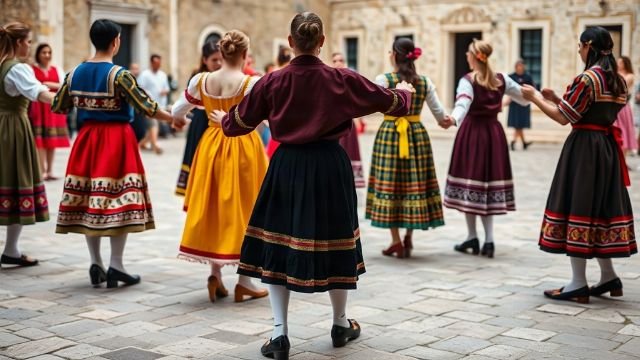
If you have heard klapa singing, you know the smooth, harmonic vocal style of the coast. The lijerica offers a contrast: its music is raw, energetic, and earthy. It is most famously paired with the linđo, a fast circle dance in which couples take turns showing off their footwork while the fiddler plays a repeating eight-bar tune. The dance is named after a legendary character, but the music itself is ancient, with roots that likely stretch back to the medieval courts of the Ragusan Republic.
Beyond the linđo, the lijerica also accompanies old wedding songs, processional tunes, and other folk customs. In Konavle, it is often played alongside the diple, a type of bagpipe, creating a rich, layered sound that has survived largely unchanged for generations.
Where to see and hear it today
The best way to experience the lijerica is in its natural setting: a warm evening in a village square, during a local feast day or summer festival. In Dubrovnik, folk ensembles regularly perform for visitors in the Old Town, and the linđo is a staple of cultural events throughout the summer. Just south of the city, the Konavle region is known for its living folk traditions, and you might catch a performance at a local celebration or during a folklore evening organised by cultural societies.
On the islands, the lijerica remains part of community life, particularly on Korčula and Lastovo. While no specific schedule is needed—spontaneous performances can happen anywhere—attending a local festivity, such as a patron saint's day or a harvest festival, greatly increases your chances of hearing the instrument up close. Many heritage museums in the region also display historic lijerice, allowing you to appreciate the craftsmanship behind these simple but beautiful instruments.
Whether you are a music lover or simply curious about Croatia's living traditions, the lijerica offers a direct connection to the sounds of the southern Adriatic. Its music is not a relic of the past but a vibrant part of community celebrations that continue to this day.