A Guide to Diocletian's Palace: Split's Living Roman Heart
Discover the UNESCO-listed palace that forms the core of Croatia's second city, with tips for exploring its ancient streets and hidden corners.

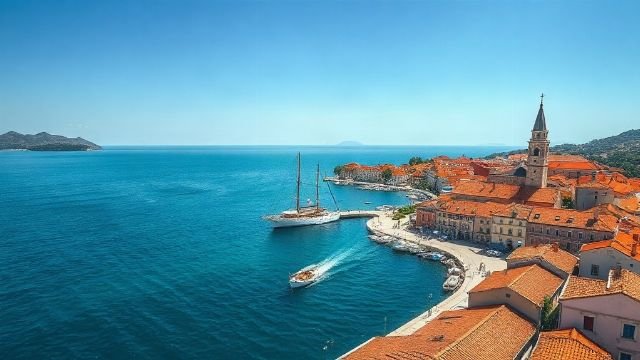
Illustration: AI-generated image
Split's old town is not just a collection of historic buildings—it is a living, breathing city that grew inside the walls of a Roman emperor's retirement home. Diocletian's Palace, built at the turn of the 4th century, is one of the best-preserved monuments of Roman architecture in the world and a UNESCO World Heritage Site. Unlike many ancient ruins, it wasn't abandoned or turned into a museum; instead, medieval residents moved in after the fall of the empire and adapted the spaces for their own needs. Today, the palace is a bustling neighbourhood with homes, shops, cafés and restaurants, all within walls that are nearly 1,700 years old.
A Palace That Became a City
Diocletian's Palace was constructed between roughly 295 and 305 AD as a residence for the Roman emperor Diocletian after his abdication. The complex covers about 30,000 square metres and was designed as a combination of a luxurious villa and a military camp. It had four main gates—the Golden Gate, Silver Gate, Iron Gate and Brass Gate—each leading to a different part of the city. The palace's rectangular layout follows the typical Roman castrum, with two main streets intersecting at the centre. Over the centuries, the palace evolved into a thriving urban centre, and its original Roman architecture blends seamlessly with later medieval, Renaissance and Baroque additions. Walking through the narrow lanes, you'll pass Roman columns next to Venetian-era windows and modern shops.
Key Sights Inside the Palace
Start your visit at the Peristyle, the grand central courtyard that served as the palace's main meeting point. The colonnaded square is surrounded by important buildings, including the Cathedral of Saint Domnius (originally Diocletian's mausoleum) and the Temple of Jupiter (now a baptistery). The Peristyle is often used for performances and events, and it's a great spot to soak up the atmosphere.
Another must-see is the basement halls (called the Podrumi), which were built to level the sloping ground and support the emperor's living quarters above. These well-preserved cellars give an insight into the original palace layout and are entered from the Riva, Split's seafront promenade. The entrance is near the Brass Gate.
Don't miss the four gates themselves. The Golden Gate, on the north side, is the most ornate and once led to the town of Salona. The Silver Gate, on the east, has a small church built inside. The Iron Gate, on the west, leads to the medieval part of the city, and the Brass Gate, on the south, opens onto the Riva.
Practical Tips for Visiting
- Wear comfortable shoes: the palace floors are made of smooth stone, often polished by centuries of foot traffic, and can be slippery when wet.
- Avoid peak crowds: the palace is busiest in July and August and during midday when cruise ship passengers arrive. Early morning or late afternoon offers a more relaxed experience.
- Look up and down: much of the palace's charm is in the details—carved capitals, ancient inscriptions, and hidden courtyards. Take time to wander without a strict route.
- Respect residents: remember that people still live inside the palace. Keep noise down in residential areas and don't peer into private homes.
- Entry: Walking around the palace and the Peristyle is free of charge. Some specific attractions, like the cathedral treasury or the basement halls, may have a small fee, but you can enjoy the atmosphere without spending a kuna.
Diocletian's Palace is more than just a tourist sight; it's the beating heart of Split. Whether you're passing through on your way to the islands or spending a few days in the city, taking the time to explore its ancient stones is an unforgettable experience.