A Slow Guide to Nin: Croatia's Tiny Royal Town and Its Salty Legacy
Discover Nin, a small historic town near Zadar known for its ancient churches, salt pans and long sandy beaches.
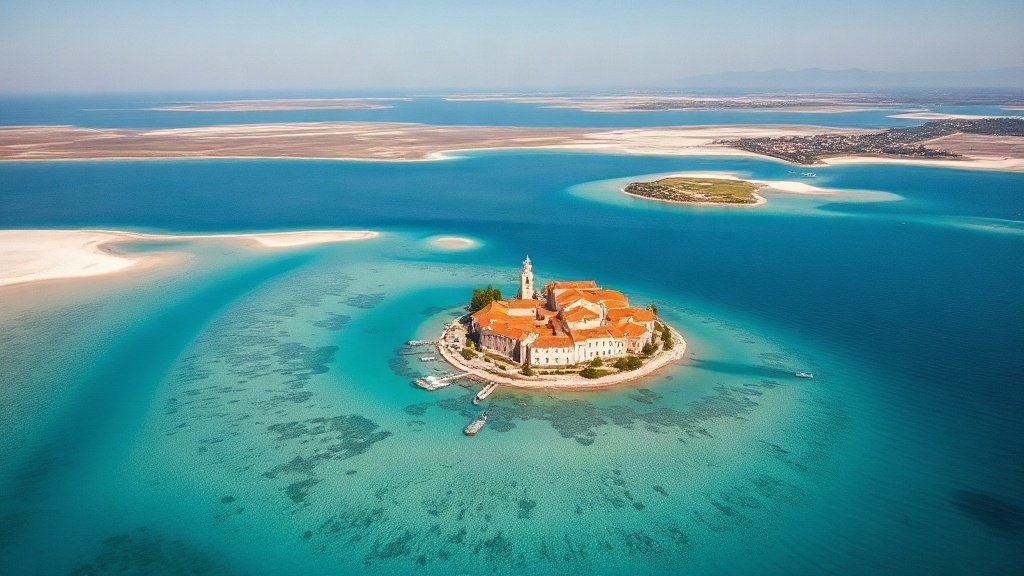
Illustration: AI-generated image
Just a short drive north of Zadar, on a tiny island connected by two bridges, lies Nin — a town so small you can walk its entire historic core in under an hour. Yet within this pocket-sized settlement you’ll find a remarkable concentration of history, from a 9th-century church often called the smallest cathedral in the world to long stretches of sandy beach that are a rarity on Croatia’s rocky Adriatic coast. Nin is a place for slow exploration, where the air carries the scent of salt and the streets still echo with centuries of royal and religious significance.
What to See in Nin
The undisputed star of Nin is the Church of the Holy Cross, a tiny pre-Romanesque building dating from the 9th century. Measuring just 7.8 by 7.8 metres, it is often described as the world’s smallest cathedral, though it was never officially a cathedral. Its simple, perfectly proportioned design and small domed roof make it one of Croatia’s most important early medieval monuments. Nearby, the remains of the Roman temple and the early Christian baptistery hint at the town’s ancient roots, while the well-preserved medieval walls and main gate offer a pleasant loop walk with views over the salt pans.
Nin also has a royal past. In the early Middle Ages it was the seat of Croatian kings and bishops, and the coronation church of the Croatian rulers once stood here. Today a bronze statue of Gregory of Nin, the 10th-century bishop who fought for the use of the Croatian language in church services, stands guard near the bridge — rubbing his big toe is said to bring good luck, though it’s best to admire rather than touch.
Beaches and Salt Pans
What makes Nin particularly appealing to families and sunseekers is its unusual sandy shoreline. The shallow, calm waters of the lagoon on the town’s western side warm up quickly in summer, making them ideal for children and less confident swimmers. The most famous stretch, known simply as Nin Beach or Kraljičina plaža (Queen’s Beach), extends for nearly three kilometres and is backed by low dunes and medicinal mud that some visitors like to slather on for a natural spa treatment.
Just beyond the beaches lie the Nin salt pans, a working landscape that has produced salt since Roman times. The pans are still in use today, and their shallow rectangular pools, surrounded by low dikes, create a striking geometric pattern that turns shades of pink and white depending on the light. A walk along the wooden boardwalk offers a close look at the traditional methods still employed, and on a breezy day the tang of salt on the air is unforgettable.
Practical Tips for Visiting Nin
Nin is compact and best explored on foot; cars are best left in the car park just outside the old town. The town can easily be visited as a half-day trip from Zadar, but staying overnight allows you to enjoy the beach without the crowds and to witness a magnificent sunset over the lagoon. Local restaurants and konobas serve simple Dalmatian fare, with fresh seafood and locally grown vegetables featuring heavily. The summer months are busiest, while late spring and early autumn offer pleasant temperatures and far fewer visitors.
Whether you come for the history, the beaches or simply the peaceful rhythm of a small Dalmatian town, Nin rewards those who take their time. It is a place that proves Croatia’s treasures don’t always need to be big to be beautiful.