A Slow Guide to Rovinj: Istria's Enchanting Coastal Town
With its pastel-coloured houses, cobbled lanes and a hilltop church overlooking the Adriatic, Rovinj is one of Croatia's most photogenic destinations.
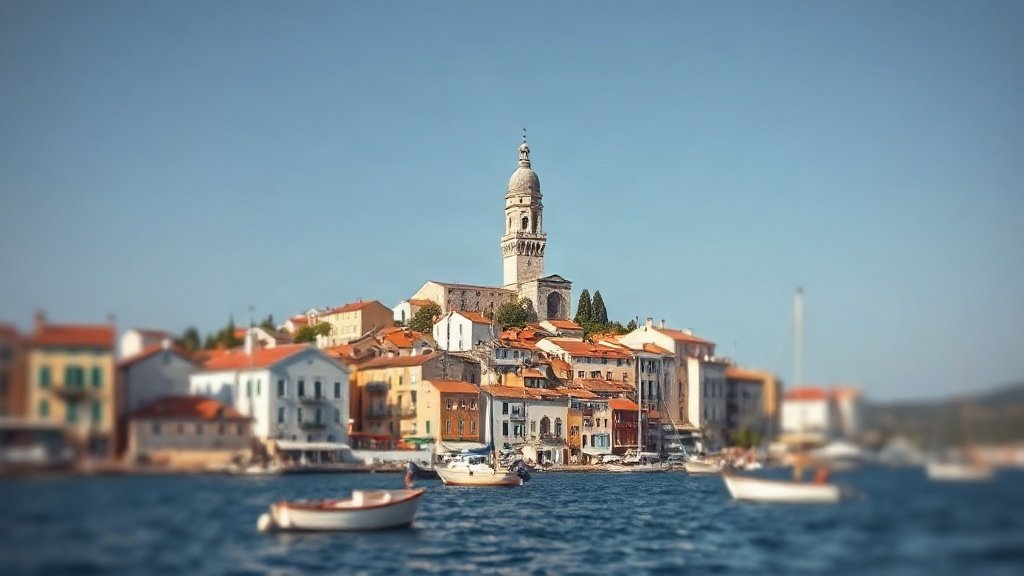
Illustration: AI-generated image
Rovinj is the kind of place that makes you stop and stare. Perched on a peninsula in western Istria, its jumble of terracotta rooftops and pastel facades seems to rise straight out of the Adriatic. Once a quiet fishing village, today it pairs old-world charm with a relaxed Mediterranean pace that’s easy to fall for.
The heartbeat of Rovinj is its old town, a warren of polished stone streets that climb gently towards the Church of St Euphemia. The baroque bell tower, modelled on St Mark’s in Venice, dominates the skyline and offers wide views over the sea and the islands beyond. Climbing the wooden stairs inside the tower is a rite of passage for visitors, though the narrow passageways and the final ladder-like steps require a steady head.
Wandering the Old Town
There is no fixed route here – getting lost is half the pleasure. Grisia, the main artists’ street, is lined with small galleries and studios selling paintings, ceramics and jewellery. Tucked behind it are quiet corners where washing lines strung between windows add a lived-in feel. Early mornings or late afternoons are the best times to wander, when the day-trippers have thinned and the stone cools underfoot.
The town’s fishing heritage is still visible around the old harbour, where small boats bob beside the waterfront cafés. The covered market near the bus station is a good spot to pick up seasonal fruit, olive oil and local truffle products. Rovinj sits at the edge of Istria’s truffle-rich forests, and the region’s strong olive oils are among Croatia’s best.
Beaches and the Shoreline
Rovinj’s coastline is mostly rocky, with concrete and pebble bathing areas rather than long sandy stretches. The most popular spots for a swim are the bays around Monte Mulini and Lone Bay, just south of the old town, where pine trees offer shade and the water is clear. Further south, the protected park forest of Zlatni Rt (Golden Cape) has a series of small coves and well-marked cycling and walking trails.
For a different perspective, take one of the small passenger boats that shuttle visitors to the nearby islands of St Katarina and St Andrija. St Katarina, the closest, has a pleasant walking path around its shoreline and a small pebble beach. The islands are also a reminder of Rovinj’s past as a Venetian outpost – the old stone quarries and monastery ruins date back centuries.
Practical Details
Rovinj is easy to reach by bus from Pula, Poreč or Trieste, and the journey from Zagreb takes around four hours by car. The town is compact enough to explore on foot, though parking outside the old town can be limited in summer – it is often easier to leave the car at one of the signed lots and walk in. English and Italian are widely understood, and many visitors combine a stay here with trips to the hilltop towns of Motovun and Grožnjan, or to the Brijuni National Park off the coast near Pula.
Rovinj rewards those who slow down. Sit with a coffee on the harbour, watch the boats come in, and let the town reveal itself at its own gentle rhythm.