Nijemo Kolo: A Guide to Croatia's Silent Circle Dance
Discover Nijemo Kolo, the UNESCO-listed silent circle dance from Croatia's Dalmatian hinterland, where rhythm comes from footwork, not music.
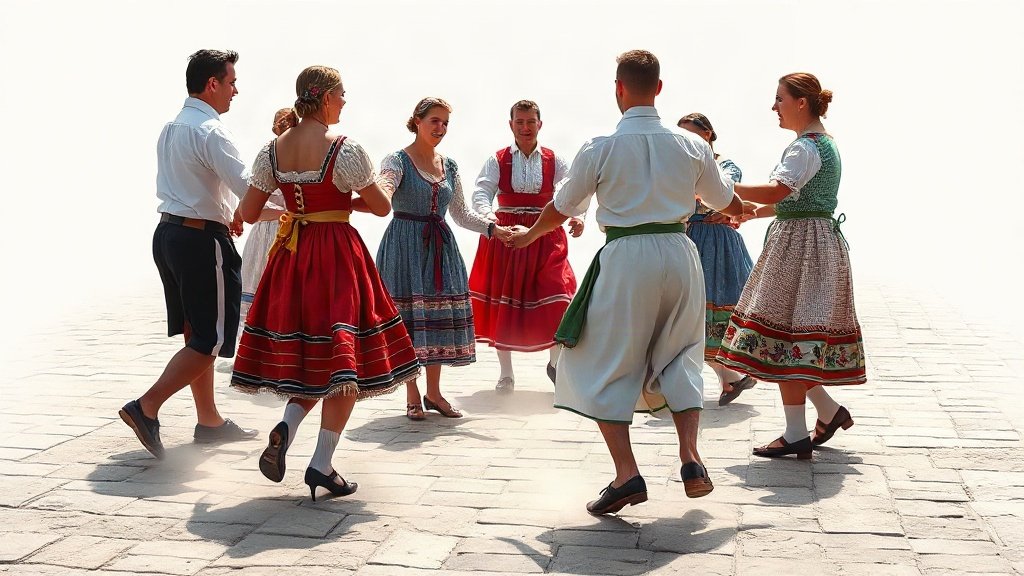
Illustration: AI-generated image
In the rugged karst landscape of Croatia's Dalmatian hinterland, a unique folk tradition thrives: Nijemo Kolo, a circle dance performed in complete silence. No instruments, no singing—just the rhythmic stamping of feet and the subtle jingle of metal bells tied around the dancers' legs. This powerful expression of community and identity has been recognised by UNESCO as an intangible cultural heritage of humanity.
What is Nijemo Kolo?
Nijemo Kolo, which translates to "silent circle dance," is traditionally performed in the regions around Sinj, Vrlika, and the Cetina valley. Unlike most folk dances that rely on musical accompaniment, the dancers themselves create the rhythm through precise footwork, heel taps, and jumps. The only additional sound comes from small brass bells, known as praporci, strapped to the dancers' lower legs, which jingle with every step.
The dance is usually performed at weddings, festivals, and other community gatherings. Dancers join hands or hold each other's belts, forming a circle that moves counterclockwise. A lead dancer, often the most skilled, improvises steps and patterns, while the rest of the circle follows in unison. The tempo can vary from slow and deliberate to fast and energetic, depending on the occasion and the dancers' skill.
How is the dance performed?
The basic structure of Nijemo Kolo is deceptively simple, but mastering it requires precision and endurance. Dancers wear traditional folk costumes: men often don white shirts, dark vests, and red caps, while women wear long skirts, embroidered blouses, and aprons. The dance is performed in a closed circle, with the dancers moving in a series of small, quick steps, punctuated by sharp heel strikes.
The lead dancer, or kolovođa, sets the pace and introduces variations: sudden turns, syncopated stamps, or dramatic leaps. The rest of the circle mirrors these movements, creating a mesmerising wave of motion. Because there is no music to guide them, the dancers must rely on an unspoken sense of rhythm and deep mutual awareness.
Where can you see it?
Nijemo Kolo is still performed in villages throughout the Dalmatian hinterland, especially during the summer festival season. The town of Sinj, famous for its Alka tournament, is a hub for the tradition, and local cultural societies often showcase the dance at events. Visitors can also see it at folk festivals in nearby towns like Vrlika and Trilj, or at regional fairs in the Cetina region.
For those unable to travel to the hinterland, occasional performances take place in larger cities like Split and Zagreb during cultural heritage days. However, the most authentic experience remains in the small villages where the dance has been passed down for generations.
Why it matters
Nijemo Kolo is more than entertainment. It is a living link to the region's pastoral and agrarian past, a way of preserving local identity in a rapidly changing world. UNESCO inscribed it on the Representative List of the Intangible Cultural Heritage of Humanity in 2011, highlighting its role in fostering social cohesion and transmitting cultural memory.
The dance is taught informally from one generation to the next, often within families or local folklore groups. It is a source of pride for the communities of the Dalmatian hinterland, and its survival is a testament to their resilience. For visitors, watching Nijemo Kolo is a window into a world where rhythm comes from the body and the earth, not from instruments.
Whether you encounter it at a village wedding or a stage performance, the silent circle dance leaves a lasting impression. Its understated power lies in its simplicity: a circle of people moving as one, bound by tradition and the beat of their own feet.