Soparnik: A Guide to Croatia's Ancient Chard Pie
Discover the history, ingredients and customs behind soparnik, the simple yet beloved Swiss chard pie from Dalmatia's Poljica region.
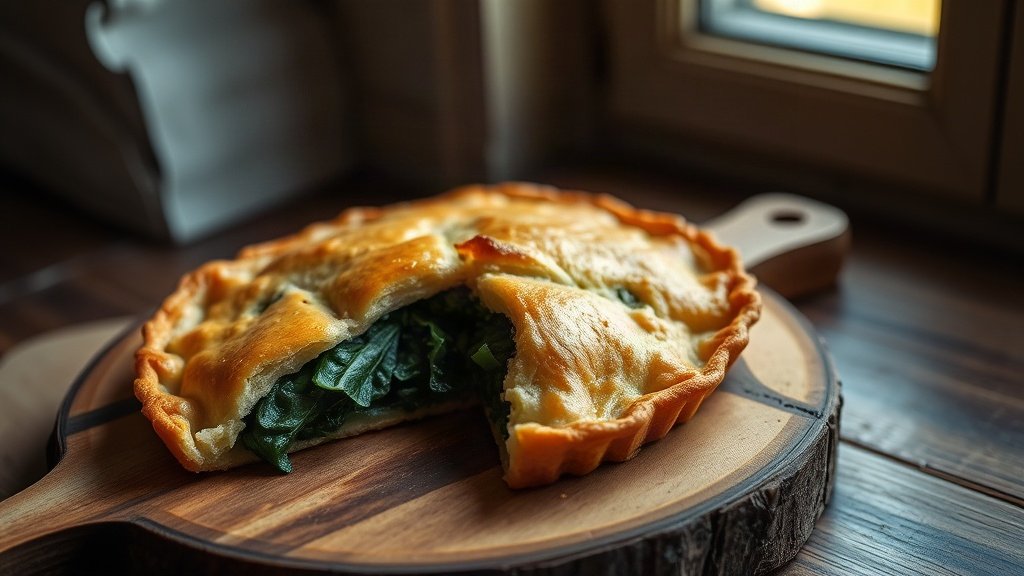
Illustration: AI-generated image
Few dishes capture the spirit of rural Dalmatia as clearly as soparnik. This humble pie, filled with Swiss chard and baked until crisp, has been made in the Poljica region for centuries. Today it holds protected status as a unique part of Croatia's culinary heritage, yet it remains a simple, honest food tied to family gatherings and feast days.
Origins and History
Soparnik comes from Poljica, a historic area that stretches inland from the coast between Split and Omiš, beneath the rocky slopes of Mount Mosor. For hundreds of years this region was a semi-autonomous community known as the Poljica Republic, with its own laws and customs. The pie likely emerged as a practical way to use abundant leafy greens, especially blitva (Swiss chard), which grows well in the Mediterranean climate.
Traditionally, soparnik was prepared for special occasions such as Christmas Eve, Easter, and the feast of the local patron saint. Because it was made with simple ingredients that every household had, it became a symbol of resourcefulness and hospitality. In recent decades it has been registered as a protected geographical indication at EU level, reflecting its cultural importance.
How It's Made
The base is a thin, unleavened dough made from flour, water, salt, and sometimes a little olive oil. It is rolled out into two large rounds, one for the bottom and one for the top. The filling is a generous mixture of chopped Swiss chard, minced garlic, salt, and olive oil, often with spring onions and parsley. Some cooks add a little potato or other wild greens, but the chard remains the star.
The filling is spread over the bottom dough, then covered with the top dough and the edges are sealed. Before baking, the top is pricked with a fork in a decorative pattern, often a cross or simple geometric shapes. This allows steam to escape and creates the pie's characteristic look.
Traditionally, soparnik is baked under a peka – a metal or clay bell covered with hot embers – or in a wood-fired oven. The high, dry heat makes the crust golden and slightly crisp while the chard inside steams and softens. The whole pie bakes for roughly 20 to 30 minutes, depending on the heat.
Serving and Enjoying
As soon as the soparnik comes out of the oven, it is brushed with a mixture of olive oil and crushed garlic. This final touch gives the crust a glossy sheen and a rich aroma. It is then cut into diamond or rectangular pieces and served warm or at room temperature.
Soparnik is usually eaten as a starter or a light meal, often alongside a glass of local red wine such as Babić or Plavac Mali. The slightly bitter chard, the sharp garlic, and the fruity olive oil balance each other perfectly.
Where to Find It
The best place to try soparnik is in the villages of the former Poljica Republic, such as Gata, Čišla, or Donji Dolac, where many family konobas and bakeries make it daily. It is also a regular feature at local fairs and cultural events throughout the Split-Dalmatia county. When made well, it is a true taste of Dalmatian tradition on a plate.