A Guide to Kažuni: Istria’s Traditional Dry-Stone Huts
Discover kažuni, the charming circular stone shelters that dot the Istrian countryside, and learn about their history, construction and cultural significance.
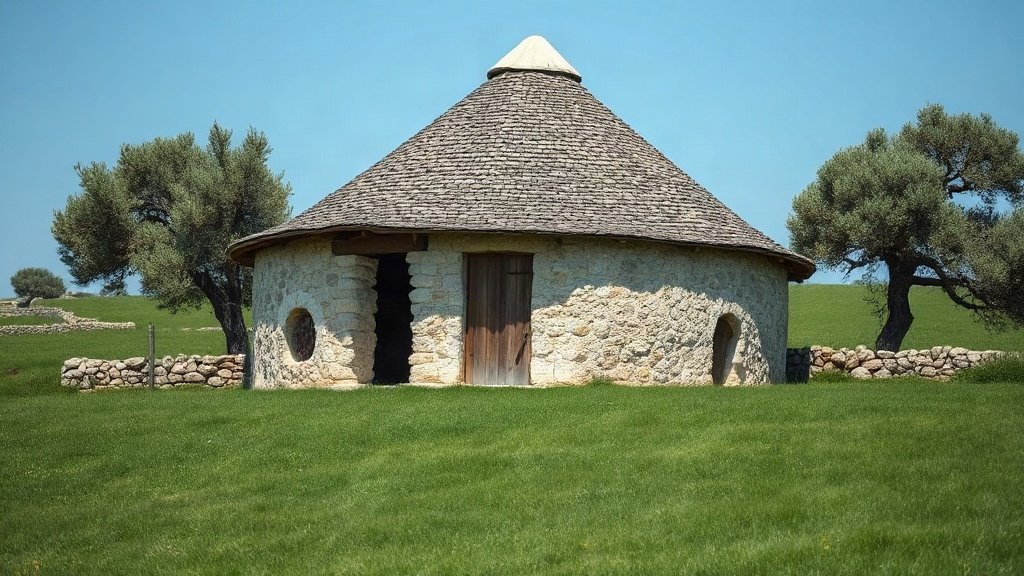
Illustration: AI-generated image
If you have ever driven through the rolling hills of Istria, you have probably spotted small, circular stone structures with conical roofs scattered across fields and olive groves. These are kažuni (singular: kažun), a distinctive feature of the rural landscape and a proud symbol of the region’s agricultural heritage.
What are kažuni?
Kažuni are dry-stone field shelters built entirely without mortar. They were traditionally used by farmers and shepherds as temporary refuges from bad weather, storage spaces for tools, or even overnight lodgings during busy seasons. Their round shape and corbelled stone roof make them both sturdy and weather-resistant, able to withstand the strong bora wind that sweeps the peninsula.
Although similar structures exist across the Mediterranean – from the trulli of Puglia to the bunje of Dalmatia – kažuni are uniquely Istrian in their proportions, materials and construction techniques. They are often found in clusters, marking old field boundaries or the edges of vineyards.
A building tradition thousands of years old
The origins of dry-stone building in Istria go back to prehistoric times, but the kažuni as we know them today took shape during the 18th and 19th centuries, when agricultural land was divided into many small plots. Farmers cleared stones from their fields and used them to build walls and shelters, a practical response to the rocky terrain.
The craft was passed down through generations, with no formal plans – builders relied on experience and a keen eye for balance. Because no mortar was used, the stones had to be carefully selected and placed so that the structure would not collapse under its own weight.
In 2018, the art of dry stone walling was inscribed on UNESCO’s Representative List of the Intangible Cultural Heritage of Humanity, recognising the knowledge and skills involved in this ancient practice across several countries, including Croatia.
Where to see kažuni in Istria
Kažuni are most concentrated in the southern and central parts of Istria, particularly around the towns of Vodnjan, Bale and Pula. They are easiest to spot while driving or cycling along rural roads – look for fields bordered by dry-stone walls, and you will often see a kažun tucked in a corner or standing alone.
Some of the best-preserved examples can be found in the Vodnjan area, where local associations have worked to restore and document these structures. The Kažun Park near Vodnjan offers an open-air display of several kažuni, along with educational panels explaining their history. While visiting, remember that many kažuni are on private land, so always view from a respectful distance unless clearly open to the public.
How kažuni are built
Building a kažun requires no specialised tools, only local stone and great skill. The walls are double-skinned, with a gap between the inner and outer faces filled with smaller rubble for insulation. The cone-shaped roof is constructed by corbelling – each successive ring of stones projects slightly inward until the opening can be closed with a single capstone.
A small entrance, usually facing away from the prevailing wind, leads into a single circular room. Some kažuni have a tiny window or a stone shelf inside. The entire structure is self-supporting, relying on compression and friction rather than any binding agent.
Why they matter today
As modern farming has reduced the need for field shelters, many kažuni fell into disrepair. However, there is a growing movement to preserve them as symbols of Istrian identity and rural heritage. Local communities organise workshops on dry-stone building, and restoration projects aim to keep these landmarks standing for future generations.
For visitors, kažuni offer a glimpse into a way of life shaped by stone, wind and hard work. They are also a reminder that traditional building techniques can be both beautiful and sustainable – using only local materials and leaving no waste behind.
Next time you travel through Istria, slow down and look for these quiet stone sentinels. They are not just relics of the past, but living proof of human ingenuity and the enduring bond between people and land.