A Guide to Plitvice Lakes: Croatia's Waterfall Wonderland
Everything you need to know for a perfect visit to Plitvice Lakes, from walking routes and boardwalks to the best times to avoid the crowds.
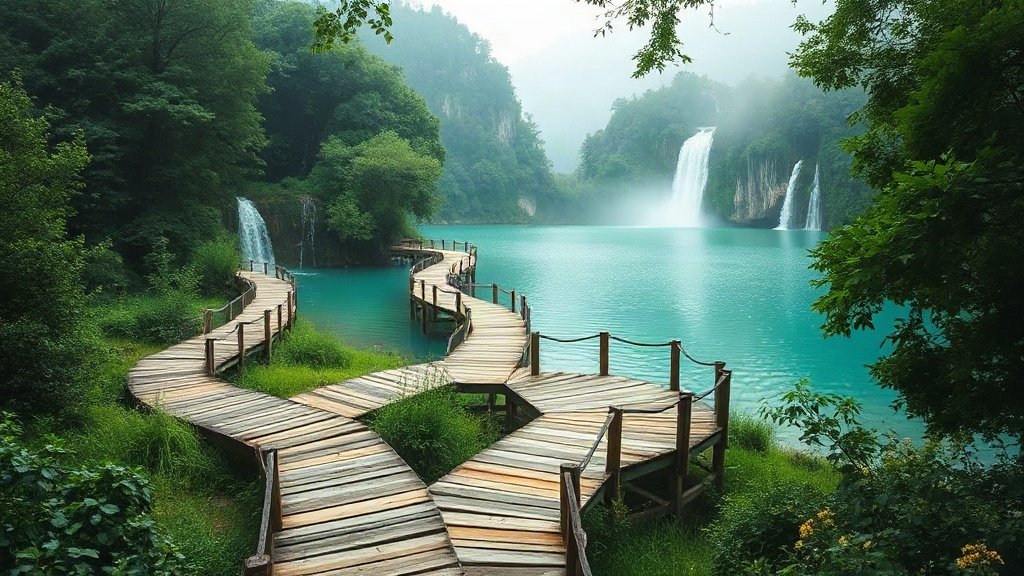
Illustration: AI-generated image
Plitvice Lakes National Park is Croatia's oldest and largest national park, a UNESCO World Heritage Site since 1979, and one of the most spectacular natural attractions in Europe. Nestled in the mountainous karst region of central Croatia, between Zagreb and Zadar, the park is a mesmerising chain of sixteen terraced lakes, connected by waterfalls and surrounded by dense beech and fir forest.
The lakes are renowned for their ever-changing colours, from azure to green, grey or blue, depending on the minerals, organisms and angle of sunlight. The lakes are divided into the Upper Lakes (Gornja jezera) and the Lower Lakes (Donja jezera), each with distinct character. The Upper Lakes are larger and calmer, while the Lower Lakes are smaller but feature the park's most dramatic waterfall, Veliki Slap, which plunges 78 metres.
Getting There
The park is easily reached by car from Zagreb (about 2 hours), Zadar (about 1.5 hours) or Split (about 2.5 hours). There are two main entrances: Entrance 1 (Rastovača) near the Lower Lakes and Entrance 2 (Hladovina) near the Upper Lakes. Regular buses connect the park with Zagreb, Zadar and Split, and many visitors also arrive on organised day tours from coastal resorts.
Exploring the Lakes
A network of wooden boardwalks, gravel paths and electric boats allows visitors to explore the lakes without disturbing the fragile ecosystem. The park offers several marked circular routes, ranging from a leisurely 2–3 hour stroll to a full-day hike of 8 hours or more. The most popular route is the 'K' programme, which covers both the Upper and Lower Lakes and includes a boat ride across Lake Kozjak and a panoramic train ride.
Highlights include walking along the boardwalks that seem to float on the water, standing at the viewpoints above Veliki Slap, and taking the boat across the emerald waters of Lake Kozjak. The park is also home to rich wildlife, including brown bears, wolves, lynx and over 160 bird species, though sightings of large mammals are rare.
Tips for a Crowd-Free Visit
Plitvice is Croatia's most visited attraction, and summer weekends can be extremely busy. To enjoy the lakes in relative peace, arrive at opening time, visit in spring or autumn, or choose one of the longer hiking routes that most tourists skip. The park's quieter sections, such as the Upper Lakes trails beyond Prošćansko Lake, offer solitude even in high season.
When to Go
Each season offers a different experience. Spring brings high water levels and lush greenery, summer offers warm weather for walking, autumn paints the forest in gold and red, and winter transforms the waterfalls into frozen sculptures. The park is open year-round, though some trails and boat services may be limited in winter.
No matter when you visit, Plitvice remains a place of extraordinary natural beauty—a must-see for any traveller to Croatia.